Ask a visitor to name a Vietnamese noodle and you'll get phở. Ask someone from Da Nang or the old Quang Nam province and you'll get an argument, and probably a bowl of mi Quang.
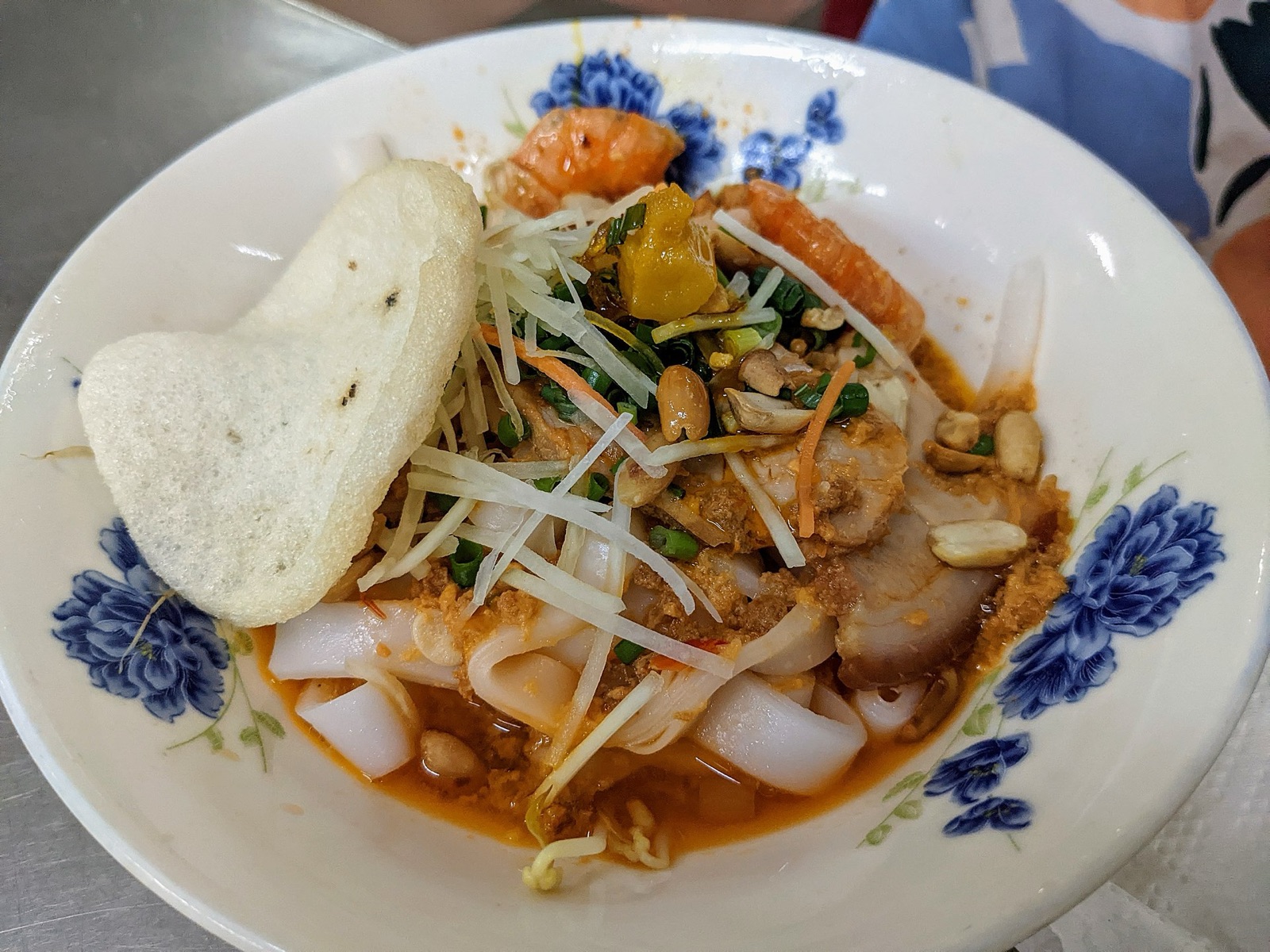
The dish is easy to describe and easy to get wrong. Wide, flat rice noodles, usually tinted yellow with turmeric, go into a bowl over a bed of fresh herbs. A small ladle of rich, deeply seasoned broth goes on top, enough to coat the noodles and wet the greens, not enough to swim in. Then come the toppings: shrimp, pork, chicken or fish, sometimes quail eggs, crushed peanuts, and a toasted sesame rice cracker, bánh tráng mè, to break over the top. Lime, fresh chili and herbs do the rest.
That small amount of broth is the whole point. Mi Quang sits somewhere between a soup and a dressed noodle salad, which is exactly why it doesn't photograph like phở and doesn't eat like it either.
Where it comes from
Mi Quang (literally "Quang noodles") comes from the old Quang Nam province, which, since July 2025, has been part of Da Nang. According to the Quang Nam People's Committee, as quoted by Viet Nam News, the dish developed alongside the southward migration of Vietnamese settlers and adapted to whatever ingredients they found locally. That history explains why there's no single "correct" mi Quang. Shrimp and pork is the classic combination, but chicken, fish, beef, frog, eel and even jellyfish versions are common, according to Wikipedia's summary of the dish.
It's also more than street food. Mi Quang is served at family gatherings, at death anniversaries and at Tết. A well-known Quang Nam folk verse has a young woman inviting her sweetheart to stay for tea and a bowl of mi Quang, a measure of how close to the heart the dish sits locally.
The heritage stamp
In August 2024, Vietnam's Ministry of Culture, Sports and Tourism added "the craft of making mi Quang" to the national list of intangible cultural heritage, in the same decision that recognized Nam Dinh-style phở, Viet Nam News reported. The ministry said the craft encapsulates the distinctive culinary values of the region. Quang Nam's provincial authorities had requested the recognition in August 2023.
Note what was recognized: the craft. The noodle-making, the broth, the knowledge of how much is enough, not a single recipe.
Where it shows up on the city's own list
Mi Quang isn't hard to find in Da Nang. It's sold from sidewalk carts, family shops and hotel buffets. But if you want a starting point backed by something other than an algorithm, the city's tourism portal publishes the 2026 Michelin Guide list for Da Nang. It includes three mi Quang specialists: Mỳ Quảng Sứa Hồng Vân, a Bib Gourmand pick whose name points to jellyfish (sứa), and Mì Quảng 1A and Mì Quảng Cô Sáu, both in the Selected category, all in Hai Chau. We haven't eaten at them for this story. They're on the list because Michelin's inspectors chose them, and that list was published in June 2026.
How to eat it like you mean it
- Toss before you eat. The broth is at the bottom and the herbs need to meet the noodles.
- Break the rice cracker over the top, or eat it alongside, a bite at a time.
- Add lime and chili a little at a time. The broth is already seasoned.
- Don't ask for more broth. Or do, and accept the looks.
Mi Quang doesn't have phở's global fame, and that may be its best feature. It is still, very specifically, from here.
Sources
- Local noodle soup designated as national intangible cultural heritage
- Mì Quảng
- Complete guide to MICHELIN-recognized restaurants in Da Nang 2026
This story was compiled by the Da Nang Voice news desk from the published sources listed above. Facts, figures and quotes are attributed to those sources; Da Nang Voice did not conduct interviews for it unless the text says so. Corrections are dated and noted at the top of the story. Read our corrections policy. Spotted an error? Tell us.