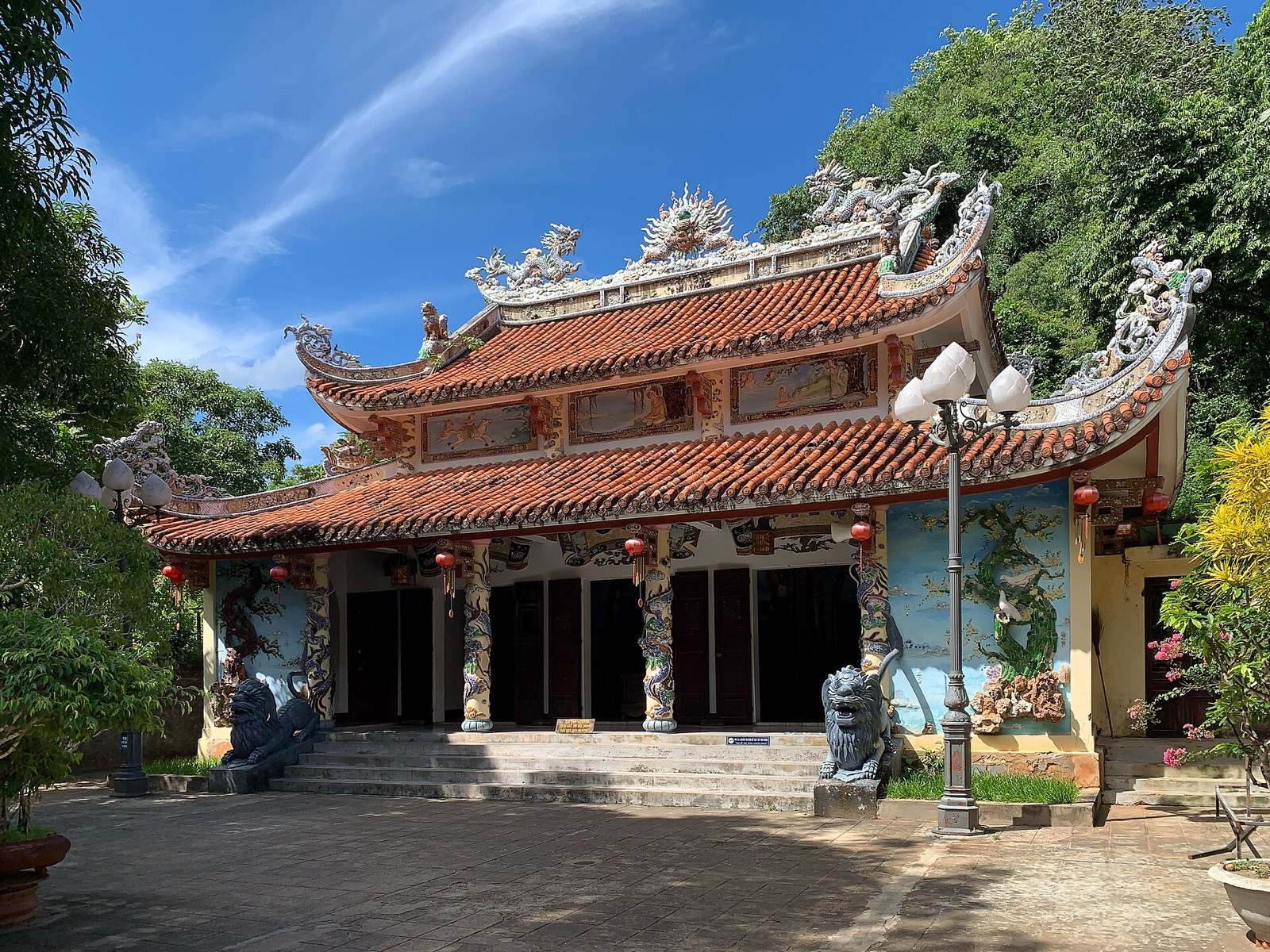
Drive south from the city center toward Hoi An and five hills rise abruptly from the flat coastal plain. They look out of place because they are: outcrops of marble and limestone in a landscape of sand and rice fields. Locals call them Ngũ Hành Sơn, the Mountains of the Five Elements. They've been a religious site, a source of stone and a hiding place, and they're now a protected national relic.
Last verified: October 11, 2026. Ticket prices and opening hours below are the city's 2026 reference prices. Check at the gate.
Five mountains, five elements
The five hills are named after the five elements of traditional East Asian philosophy: Kim (metal), Thủy (water), Mộc (wood), Hỏa (fire) and Thổ (earth), according to Wikipedia. They stand in Ngũ Hành Sơn ward, south of the city center and a short way inland from the beach.
All of them have cave entrances and tunnels, but most visitors see only one: Thủy Sơn, the water mountain, which has the stairways, pagodas and ticket gates.
What's on Thủy Sơn
A stairway of 156 steps leads to the top of Thủy Sơn. Along the way and inside the mountain are grottoes, including Huyền Không and Tàng Chơn, and pagodas and temples including Tam Thai, Từ Tâm, Linh Ứng and Phổ Đồng, according to Wikipedia.
The pagodas are active places of worship, not props. Dress modestly, keep your voice down and don't climb on the altars or statues.
Âm Phủ Cave, whose name refers to the underworld, is ticketed separately.
Tickets and hours
According to the city tourism portal's 2026 price list:
- Thủy Sơn: 40,000 dong for adults and 10,000 dong for students. Children under 6 are free. Open 7 a.m. to 5 p.m.
- Âm Phủ Cave: 20,000 dong for adults and 7,000 dong for students. Under-6s are free. Same hours.
- Non Nước stone carving village, at the foot of the mountains: free.
A mountain with a war history
The caves weren't always quiet. During the American war, the Marble Mountains housed a hospital for the Viet Cong, according to Wikipedia, in the same city as a major U.S. base, the Da Nang air base. The Cham were here earlier still. Sculpture from the Champa period has been found at the site. To see the art the Cham left behind across the region, go to the Museum of Cham Sculpture.
Protecting the mountain from its own industry
The mountains gave the area its trade. The neighborhood around them is known for stone sculpture and stone cutting, and the Non Nước stone carving village sits at their foot.
For decades, some of that stone came straight out of the mountains themselves. That's no longer allowed. Direct extraction from the mountains has been banned, and carvers now bring in stone from quarries in what was Quảng Nam province, according to Wikipedia. On January 20, 2019, the Marble Mountains were certified as a National Special Relic, Vietnam's highest heritage category for sites of this kind.
When you browse the workshops, remember that big pieces are heavy and shipping is expensive. Ask for a written quote that includes delivery before you agree to anything.
How to visit
- Go early. The steps are steep and the heat builds fast. Opening time is 7 a.m.
- Wear shoes with grip. Cave floors and stone steps get slippery, especially in the rainy season.
- Bring a light. A phone torch helps inside the darker caves.
- Combine it. The mountains are on the road between Da Nang and Hoi An, so they pair well with a day trip or the beaches at the southern end of the city. See our beach guide.
Sources
- Marble Mountains (Vietnam)
- Plan Your Da Nang Journey 2026: Updated Admission Prices for Attractions and Tourist Sites
This story was compiled by the Da Nang Voice news desk from the published sources listed above. Facts, figures and quotes are attributed to those sources; Da Nang Voice did not conduct interviews for it unless the text says so. Corrections are dated and noted at the top of the story. Read our corrections policy. Spotted an error? Tell us.